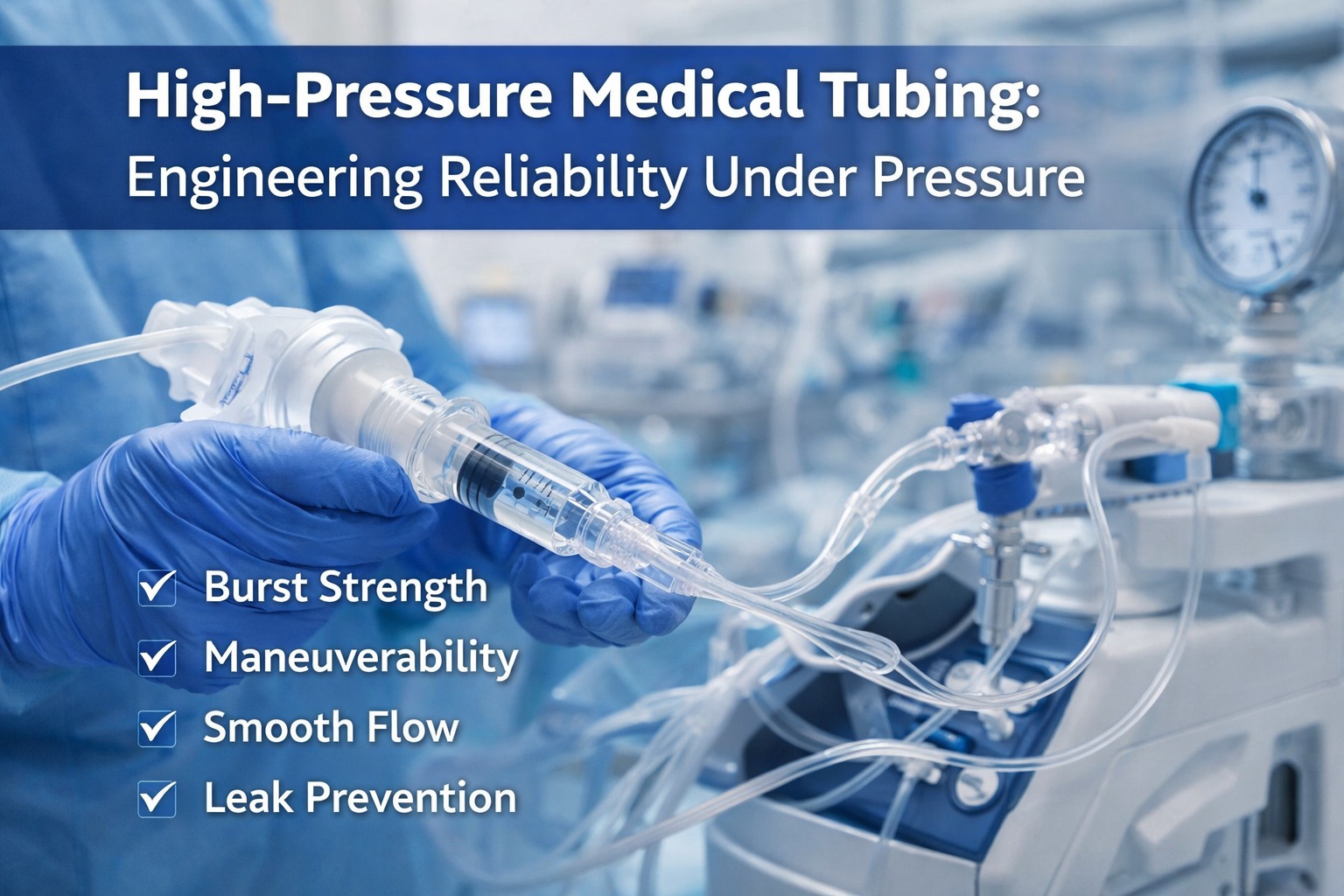
Meeting Pressure Standards: Engineering Tubing for Demanding Clinical Use Cases
In modern interventional medicine, precision often depends on pressure. From contrast delivery in angiography to balloon inflation during cardiac procedures, medical tubing must perform flawlessly under demanding conditions. Even minor inconsistencies in pressure resistance or flow dynamics can disrupt procedures and compromise patient safety.
High-pressure medical tubing may appear simple in structure, but behind its design lies advanced engineering focused on durability, flexibility, and reliability. Meeting stringent pressure standards is not just a regulatory requirement; it is a clinical necessity.
Why Pressure Performance Matters in Clinical Settings
High-pressure tubing is widely used in interventional cardiology, radiology, and vascular procedures, where controlled delivery of fluids or contrast media is essential for visualization and treatment accuracy. In procedures such as coronary angioplasty or CT contrast injection, pressures can exceed 1,000 psi. Under these conditions, tubing must withstand intense internal force without bursting, leaking, or kinking. Failure in pressure performance can result in:
- Procedure delays
- Contrast leakage and imaging errors
- Compromised sterility
- Increased procedural risk
Therefore, pressure standards in tubing design directly influence procedural efficiency and patient outcomes.
Burst Strength: The Foundation of Reliability
One of the most critical engineering parameters in high-pressure tubing is burst strength; the maximum pressure the tubing can tolerate before failure. Modern tubing is manufactured using reinforced medical-grade polymers that provide exceptional tensile strength while maintaining flexibility. Multi-layer extrusion techniques are often employed to create tubing walls that resist expansion under pressure.
Rigorous burst testing ensures that each batch meets defined safety margins well above expected clinical pressures. This testing provides clinicians with confidence that the tubing will perform predictably during high-stakes procedures. Manufacturers such as MedivationBio prioritize pressure validation and material integrity to ensure tubing reliability across demanding interventional environments.
Flexibility Without Compromise
While strength is essential, rigidity can create its own challenges. Tubing must navigate complex anatomical pathways and procedural setups without collapsing or restricting flow. Engineering flexibility into high-pressure tubing involves:
- Selecting polymers that balance elasticity with strength
- Optimizing wall thickness to prevent kinking
- Reinforcing layers without sacrificing maneuverability
The ability to bend smoothly without compromising lumen integrity is critical in dynamic procedural settings where equipment positioning changes frequently.
Smooth Lumen Design for Flow Precision
Flow consistency is equally important in high-pressure applications. A smooth internal lumen reduces turbulence, minimizes resistance, and ensures controlled fluid delivery.
In contrast-enhanced imaging, precise flow rates are essential for accurate visualization. Variations in flow can impact image quality and diagnostic clarity. Similarly, in balloon inflation procedures, controlled pressure transmission is vital for procedural accuracy. Advanced extrusion technologies help achieve uniform internal surfaces, supporting predictable fluid dynamics even under extreme pressure conditions.
Secure Connections and Leak Prevention
High-pressure tubing does not operate in isolation. It connects with syringes, inflation devices, catheters, and contrast injectors. Secure, leak-proof connectors are therefore an integral part of tubing engineering. Modern designs incorporate:
- Precision-molded connectors
- Tight-tolerance fittings
- Reinforced bonding between tubing and hubs
Leak prevention is particularly critical in contrast delivery, where even minor leakage can reduce procedural effectiveness and compromise sterility.
Compliance With International Standards
Engineering tubing for demanding clinical use requires strict adherence to global medical device standards. Pressure validation, material biocompatibility testing, and sterilization integrity all contribute to product reliability. Manufacturing processes typically involve:
- Controlled extrusion environments
- Continuous quality monitoring
-
Batch traceability and performance testing
These quality systems ensure that tubing not only meets pressure thresholds but maintains consistent performance across high-volume production.
Supporting Diverse Clinical Applications
High-pressure tubing must adapt to multiple medical disciplines. In cardiology, rapid balloon inflation demands precise pressure transmission. In radiology, high-speed contrast injection requires stable burst resistance and flow clarity. Design considerations may include:
- Transparent materials for visual confirmation
- Radiopaque elements when necessary
-
Compatibility with various injection systems
By addressing diverse clinical requirements, modern tubing engineering supports versatility without compromising safety.
Engineering Confidence Under Pressure
In high-pressure medical procedures, reliability is not optional; it is engineered. From burst strength and flexibility to smooth lumen design and secure connectors, every detail contributes to safer and more efficient interventions. As interventional techniques continue to advance, the demands placed on medical tubing will only increase. Meeting these pressure standards requires continuous innovation in material science, precision manufacturing, and quality assurance.
Though often overlooked, high-pressure tubing plays a pivotal role in modern medicine, quietly supporting life-saving procedures where accuracy and performance must never falter.
