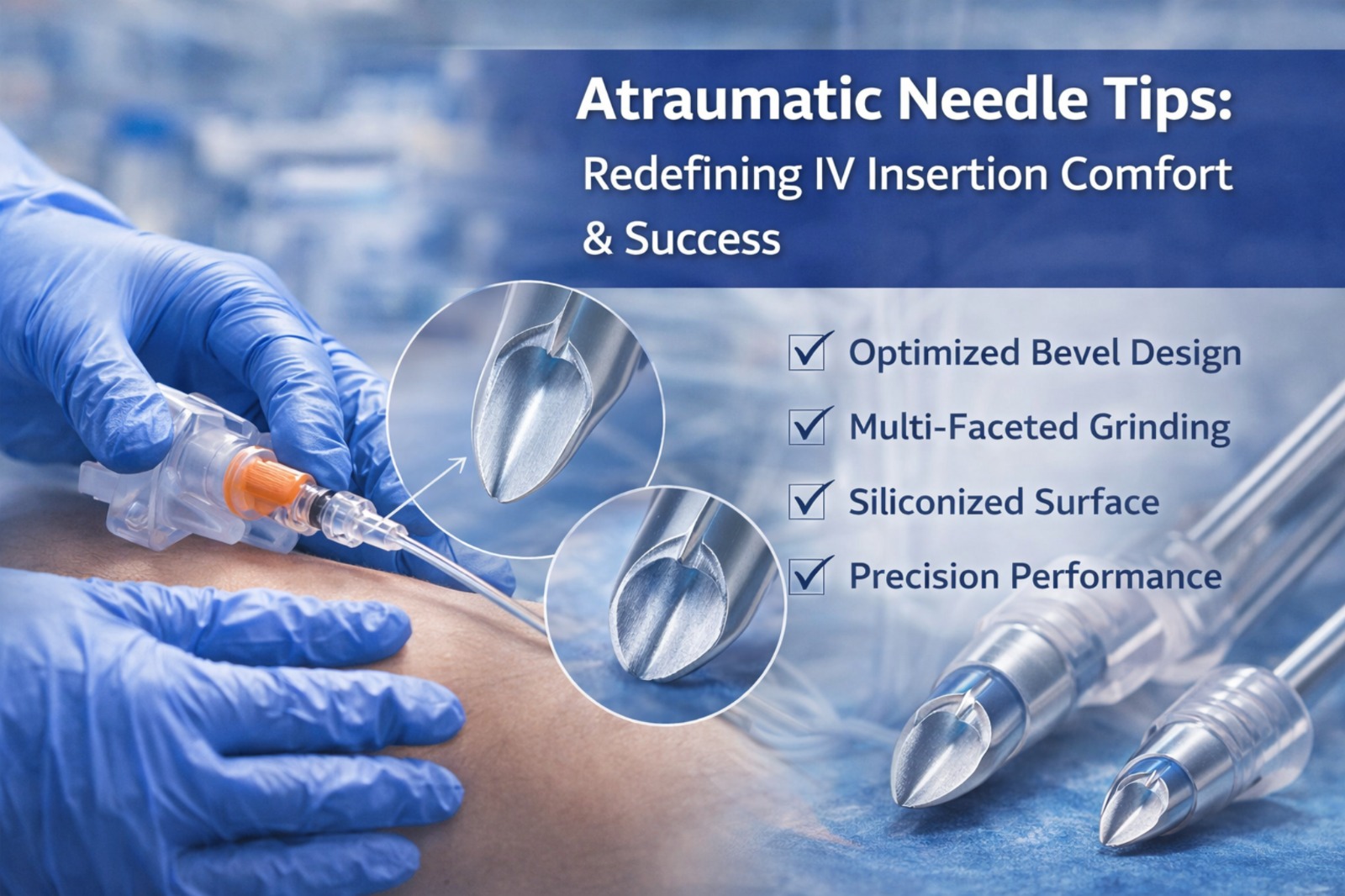
The Science Behind Atraumatic Needle Tips in Modern IV Cannulas
Intravenous therapy is one of the most frequently performed medical procedures worldwide. Yet despite its routine nature, IV insertion remains a critical moment in patient care, one that can determine comfort, efficiency, and clinical success. At the center of this experience lies a small but powerful innovation: the atraumatic needle tip.
Modern IV cannulas have evolved significantly over the years, and one of the most impactful advancements has been in needle tip design. Engineered for precision and reduced tissue trauma, atraumatic needle tips are redefining how clinicians achieve reliable venous access while improving patient outcomes.
Why Needle Tip Design Matters
When inserting an IV cannula, the needle must pass through skin and vein walls with minimal resistance and damage. Traditional needle designs, while functional, often caused unnecessary tissue disruption, increasing the likelihood of bruising, infiltration, phlebitis, and patient discomfort.
Clinical data suggests that failed first-attempt insertions occur in up to 30-40% of patients, particularly among pediatric, geriatric, and difficult-access populations. Each failed attempt increases patient anxiety, delays therapy, and raises the risk of complications. This is where the science of atraumatic needle engineering becomes critical.
The Engineering Principles Behind Atraumatic Tips
Modern atraumatic needle tips are developed using precision grinding and advanced bevel geometry to reduce insertion force and tissue damage. Key design elements include:
1. Optimized Bevel Angle
The bevel angle determines how smoothly the needle penetrates the skin and vein. A carefully calculated angle reduces resistance during entry, allowing for cleaner penetration with less drag.
2. Multi-Faceted Grinding
Advanced grinding techniques create sharper, smoother edges. Multi-faceted bevels distribute force evenly, reducing tissue tearing and improving insertion control.
3. Precision Tip Symmetry
Uniform symmetry ensures predictable penetration and reduces the risk of lateral vein wall damage. This is especially important in fragile or narrow veins.
4. Siliconization and Surface Treatment
Specialized coatings reduce friction between the needle and tissue, contributing to smoother insertion and decreased patient discomfort.
Together, these engineering refinements allow the needle to glide through tissue rather than push or tear through it.
Clinical Benefits of Atraumatic Needle Design
The scientific improvements in needle tip geometry translate directly into measurable clinical advantages:
- Higher First-Attempt Success Rates: Reduced resistance improves insertion precision.
- Lower Risk of Vein Trauma: Minimizing tissue disruption reduces inflammation and phlebitis.
- Reduced Patient Pain and Anxiety: Smoother penetration improves the overall procedural experience.
- Decreased Reinsertion Rates: Fewer failed attempts lead to better workflow efficiency and lower resource utilization.
For healthcare systems focused on value-based care, these outcomes matter. Reduced complications mean shorter treatment delays, improved patient satisfaction, and better overall clinical performance metrics.
Impact on Vulnerable Patient Populations
The importance of atraumatic needle tips becomes even more evident in vulnerable groups.
Pediatric Patients
Children have smaller, more elastic veins and heightened procedural anxiety. Fine-gauge cannulas with precision-ground atraumatic tips help minimize pain and increase insertion success.
Geriatric Patients
Older adults often present with fragile, sclerosed veins and thinner skin. Atraumatic tips reduce the risk of bruising and vein rupture, supporting safer IV access.
Critical Care & Emergency Settings
In high-pressure environments, clinicians require devices that support rapid, reliable insertion. Atraumatic designs improve confidence and consistency when time is critical.
Beyond the Needle: Integration With Catheter Design
While the needle tip initiates access, the catheter that follows must maintain vein integrity. Modern IV cannulas integrate atraumatic needle tips with flexible, biocompatible catheter materials to create a seamless transition during insertion.
Manufacturers such as MedivationBio focus on aligning needle precision with catheter flexibility and kink resistance. This integrated approach ensures that smoother entry is followed by stable, uninterrupted infusion therapy, reducing both mechanical and inflammatory complications. The result is not just a sharper needle, but a system engineered for safer venous access.
Manufacturing Precision and Quality Assurance
The science behind atraumatic needle tips extends into manufacturing. High-precision grinding equipment, automated inspection systems, and rigorous quality control processes ensure consistency across production batches.
Microscopic deviations in tip geometry can alter performance, making stringent validation and testing essential. Sterilization integrity and material quality further ensure that the final device performs exactly as designed. In modern consumable manufacturing, precision at the micro level directly influences macro-level patient outcomes.
Small Design, Significant Impact
Atraumatic needle tips may represent a small design feature, but their clinical implications are substantial. By reducing insertion force, minimizing tissue trauma, and improving first-attempt success, they enhance both patient experience and healthcare efficiency.
In an era where healthcare increasingly prioritizes safety, comfort, and measurable outcomes, the science behind needle tip design demonstrates a powerful truth: innovation does not always need to be large to be transformative; Sometimes, it begins at the very tip.
