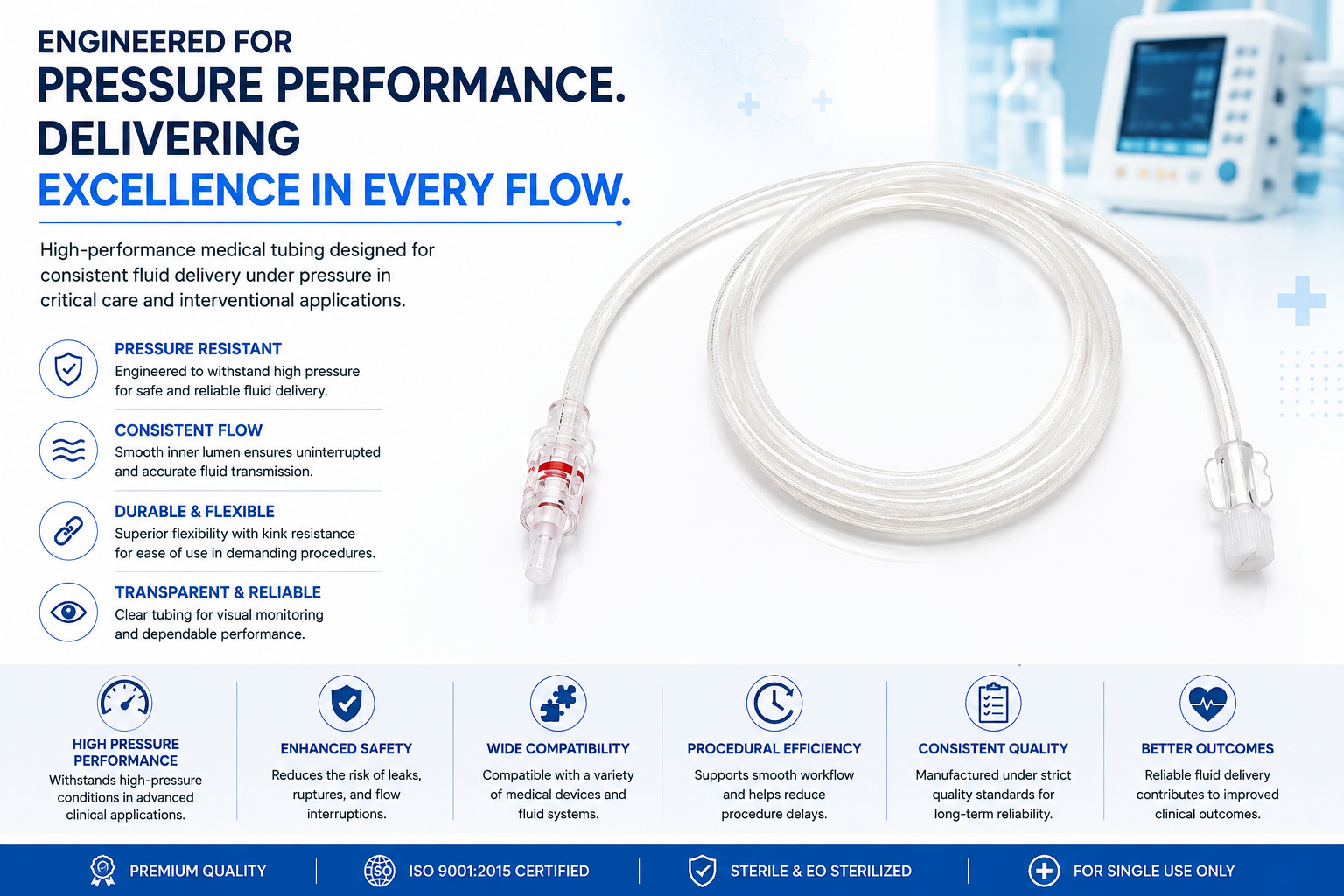
Designing Medical Tubing for Consistent Performance Under Pressure
In modern healthcare, precision is not limited to advanced imaging systems or sophisticated monitoring equipment; it also depends on the reliability of the medical consumables used every day. Among these, medical tubing plays a vital role in ensuring the safe and consistent delivery of fluids, medications, and contrast media across a wide range of clinical procedures.
Whether in interventional cardiology, intensive care, diagnostic imaging, or surgical settings, high-pressure medical tubing must perform flawlessly under demanding conditions. Even minor inconsistencies in tubing performance can affect fluid delivery, compromise procedural efficiency, or increase the risk of device failure. As healthcare procedures become increasingly complex, the focus has shifted from simply manufacturing tubing to engineering solutions that offer pressure resistance, durability, flexibility, and dependable clinical performance.
Why Pressure Performance Matters in Clinical Practice
Medical tubing is responsible for transporting fluids between devices and patients under carefully controlled conditions. In many clinical applications, these fluids are delivered under elevated pressures to meet procedural requirements. Examples include:
- Contrast media injection during CT and angiography procedures
- Hemodynamic pressure monitoring
- Interventional cardiology procedures
- Infusion systems requiring controlled fluid delivery
- Critical care monitoring
In these environments, tubing must maintain structural integrity while delivering fluids with consistent flow characteristics. Any compromise in pressure handling can lead to inaccurate delivery, interruptions, or procedural delays. Reliable tubing performance is therefore essential for both patient safety and clinical efficiency.
Engineering for Strength Without Compromising Flexibility
One of the biggest challenges in designing medical tubing is achieving the right balance between mechanical strength and flexibility. Tubing that is too rigid may become difficult to position, increasing the complexity of clinical procedures. On the other hand, overly flexible tubing may be prone to kinking, collapsing, or deformation when exposed to higher pressures.
Modern medical tubing is engineered using advanced polymers and optimized wall thickness to achieve:
- High burst-pressure resistance
- Controlled flexibility
- Resistance to kinking
- Dimensional stability
- Consistent internal lumen geometry
This combination allows clinicians to work confidently without compromising procedural efficiency.
Maintaining Consistent Flow Under Pressure
Delivering fluids consistently is just as important as delivering them safely. Variations in internal tubing dimensions or material performance can influence flow characteristics, particularly during high-pressure applications. Well-engineered tubing helps maintain:
- Stable flow rates
- Predictable pressure response
- Uniform fluid delivery
- Reliable device compatibility
This consistency is particularly valuable in procedures where accurate timing and precise fluid administration directly influence diagnostic quality or therapeutic outcomes.
Material Selection: A Critical Design Decision
The performance of medical tubing begins with the materials used to manufacture it. Material selection influences multiple aspects of clinical performance, including:
- Pressure tolerance
- Chemical compatibility
- Transparency for visual inspection
- Durability during prolonged procedures
- Resistance to cracking and fatigue
Healthcare manufacturers carefully evaluate polymer characteristics to ensure tubing can withstand repeated pressure cycles while maintaining performance throughout its intended use. The result is a medical device that performs reliably even under challenging clinical conditions.
Designing for Real-World Clinical Environments
Medical tubing must perform consistently across diverse healthcare settings, not only in controlled laboratory testing but also during everyday clinical use. Engineers consider several practical factors during product development, including:
- Compatibility with multiple medical devices
- Ease of connection and secure fittings
- Resistance to accidental kinking
- Smooth handling during procedures
- Consistent performance across varying pressure levels
These considerations help ensure that clinicians can focus on patient care rather than equipment-related interruptions.
Reducing Risk Through Better Tubing Design
Although medical tubing may appear simple, its design can significantly influence procedural safety. Poorly designed tubing may contribute to:
- Pressure fluctuations
- Flow inconsistencies
- Connection instability
- Leakage
- Equipment downtime
- Delayed clinical procedures
By incorporating robust engineering principles and rigorous quality controls, manufacturers help reduce these risks while improving the overall reliability of healthcare systems. This focus on preventive engineering supports safer clinical practice across hospitals and specialty care settings.
The Role of Quality Manufacturing
Design alone is not enough to ensure reliable tubing performance. Manufacturing precision is equally important. Consistent production processes help maintain:
- Accurate dimensional tolerances
- Uniform wall thickness
- Material consistency
- Secure connector integrity
- Reliable pressure performance across production batches
Comprehensive quality assurance and testing further validate that each product meets demanding clinical expectations before reaching healthcare providers. This combination of engineering excellence and manufacturing precision forms the foundation of dependable medical tubing.
Innovation Is Shaping the Future of Medical Tubing
As healthcare technology continues to evolve, so do the expectations placed on medical consumables. Today's innovations in tubing design include:
- Advanced polymer formulations
- Improved pressure resistance
- Enhanced flexibility
- Reduced device weight
- Better compatibility with automated infusion and monitoring systems
These developments support more efficient workflows while helping clinicians perform increasingly sophisticated procedures with confidence. The future of medical tubing lies not only in handling higher pressures but also in delivering greater precision, usability, and reliability. The performance of high-pressure medical tubing is determined long before it reaches a clinical setting. Material selection, manufacturing precision, and rigorous performance testing all contribute to its ability to deliver fluids safely under demanding conditions.
By integrating these engineering principles into product development, a leading manufacturer like Medivation Bio strives to deliver tubing solutions that healthcare professionals can depend on for consistent performance across a variety of interventional and diagnostic procedures.
Conclusion
Medical tubing is an essential component of modern healthcare, supporting everything from diagnostic imaging to critical care interventions. Its ability to maintain consistent flow under pressure directly impacts procedural success, equipment performance, and patient outcomes.
By combining advanced materials, intelligent engineering, and rigorous quality manufacturing, modern medical tubing continues to meet the growing demands of today's healthcare environment. As clinical procedures become increasingly sophisticated, investing in high-quality, pressure-resistant tubing is not simply a technical decision, it is a commitment to safer, more efficient, and more reliable patient care.
