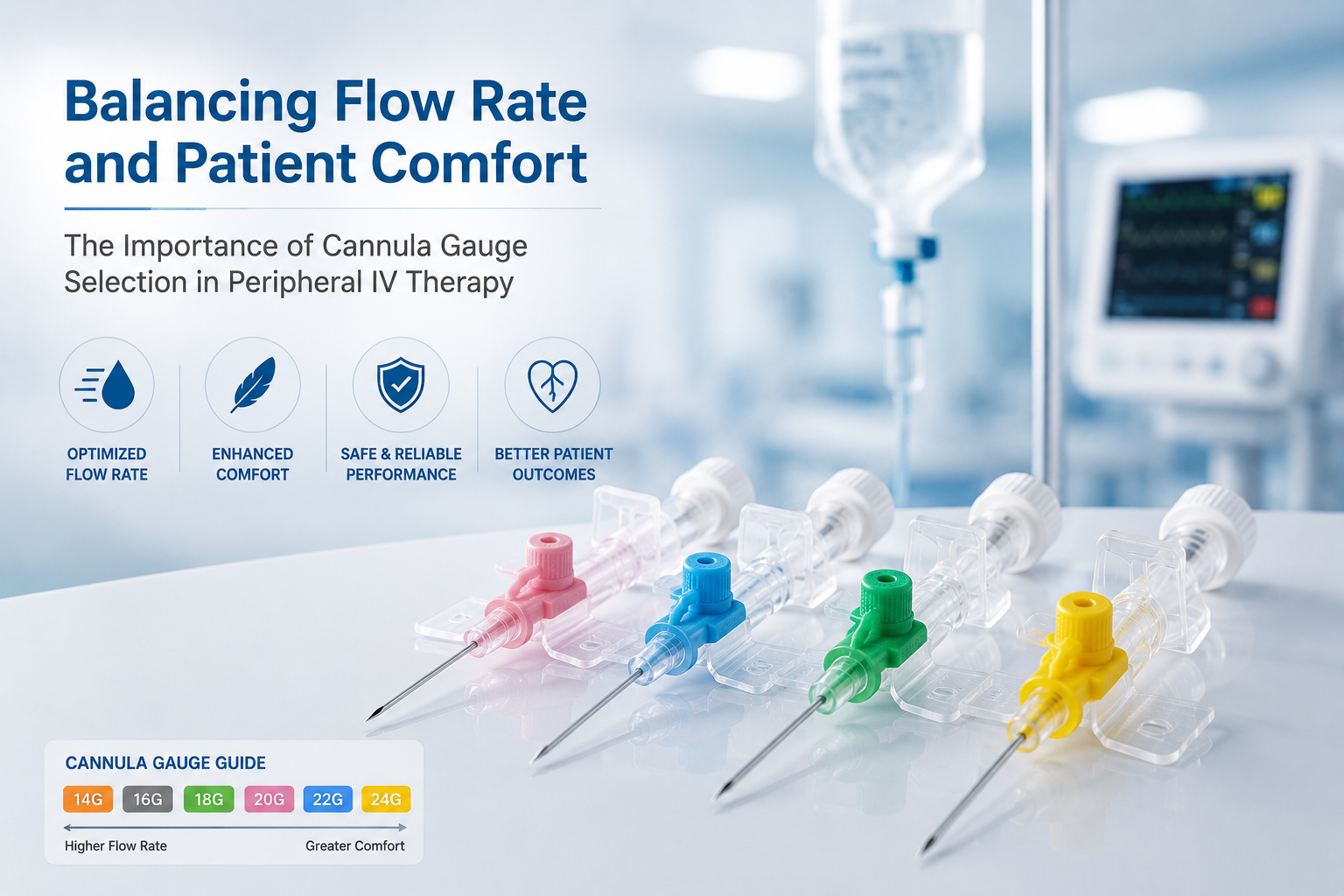
Balancing Flow Rate and Patient Comfort in Peripheral IV Therapy
Peripheral intravenous (IV) therapy is one of the most frequently performed clinical procedures worldwide. From emergency fluid resuscitation to medication delivery and routine hydration, IV access plays a vital role in modern healthcare. Yet despite its routine nature, successful IV therapy depends on a careful balance between two critical factors: flow rate and patient comfort.
Choosing the right cannula gauge is not simply a technical decision, it directly affects treatment efficiency, vein health, and the overall patient experience. In today’s healthcare environment, clinicians are increasingly focused on selecting IV devices that optimize both clinical performance and patient-centered care.
Understanding Flow Rate in Peripheral IV Therapy
Flow rate refers to the speed at which fluids or medications are delivered through an IV cannula. It is influenced by several factors, including:
- Cannula gauge size
- Internal catheter diameter
- Fluid viscosity
- Infusion pressure
Larger gauge cannulas allow higher flow rates and are commonly used in emergency settings where rapid fluid or blood administration is required. Smaller gauges, on the other hand, are better suited for slower infusions and patients with delicate veins. The challenge lies in selecting a cannula that delivers the required flow without causing unnecessary discomfort or vascular trauma.
Why Cannula Gauge Selection Matters
Cannula gauge selection is one of the most important decisions in IV therapy. Larger cannulas provide faster flow but may increase insertion discomfort and the risk of vein irritation. Smaller cannulas improve patient comfort but may limit infusion efficiency in high-demand situations. For example:
- 14G-18G cannulas are often used in trauma care, surgery, and emergency medicine for rapid fluid replacement.
- 20G-22G cannulas are commonly preferred for routine medication administration and general patient care.
- 24G cannulas are frequently used in pediatric or geriatric patients where vein preservation is essential.
Selecting an unnecessarily large cannula can increase pain, infiltration risk, and mechanical phlebitis. Conversely, using a cannula that is too small may delay treatment due to inadequate flow rates. This makes proper gauge selection a key component of effective IV therapy best practices.
The Link Between Flow Rate and Patient Comfort
Patient comfort is increasingly recognized as a critical quality indicator in healthcare. Repeated insertion attempts, painful cannulation, and prolonged vein irritation can negatively affect patient trust and cooperation. Several factors influence comfort during peripheral IV therapy:
- Needle sharpness and insertion smoothness
- Catheter flexibility and biocompatibility
- Cannula size relative to vein diameter
- Stability during movement and prolonged use
Modern IV cannulas are engineered to reduce trauma while maintaining efficient fluid delivery. Features such as ultra-sharp needle tips, flexible catheter materials, and optimized wall thickness help minimize discomfort without compromising performance.
Manufacturers such as Medivation Bio focus on designing IV cannulas that support both clinical efficiency and patient-centered care, helping clinicians achieve reliable access with reduced vascular stress.
Clinical Decision-Making in Cannula Selection
Effective IV therapy requires clinicians to evaluate multiple factors before selecting a cannula.
1. Therapy Requirements
Rapid transfusion or emergency resuscitation demands higher flow rates and larger gauge cannulas. Routine hydration or antibiotic administration may require smaller gauges for improved comfort.
2. Patient Population
Pediatric, geriatric, and oncology patients often have fragile veins that benefit from smaller, more flexible cannulas designed to minimize trauma.
3. Duration of Therapy
Short-term infusions may tolerate larger gauges when clinically necessary, while longer dwell times often favor smaller, more comfortable devices.
4. Vein Quality and Access Difficulty
Preserving vein integrity is essential in patients requiring repeated IV access. Appropriate gauge selection helps reduce vessel damage and maintain future access options.
This individualized approach reflects the growing emphasis on personalized and evidence-based IV therapy practices.
Preventing Complications Through Better Device Selection
Improper cannula selection contributes significantly to IV-related complications, including:
- Phlebitis
- Infiltration
- Occlusion
- Premature device failure
Studies indicate that many peripheral IV lines fail before therapy completion, often due to mechanical irritation or poor device selection. Using the smallest appropriate gauge for the required therapy is widely recommended as a best practice. This strategy helps:
- Reduce vein trauma
- Improve patient comfort
- Extend catheter dwell time
- Lower reinsertion rates
Advancements in catheter design further support complication reduction by improving flexibility, stability, and insertion success.
Engineering Innovations Supporting Better Outcomes
Modern peripheral IV cannulas are no longer simple access devices, they are precision-engineered clinical tools. Key innovations include:
- Thin-wall catheter technology to maximize flow despite smaller external diameters
- Atraumatic needle designs for smoother insertion
- Kink-resistant catheters for uninterrupted infusion
- Biocompatible materials that reduce irritation and inflammation
These advancements allow clinicians to achieve effective flow rates while prioritizing patient comfort and vascular health.
A Patient-Centered Approach to IV Therapy
As healthcare continues to evolve, IV therapy is becoming increasingly patient-focused. Clinicians are expected not only to deliver treatment effectively but also to minimize pain, anxiety, and complications throughout the process.
Balancing flow rate and comfort requires thoughtful clinical judgment, supported by well-engineered devices designed for diverse patient needs. The right cannula choice can improve therapy efficiency, reduce procedural complications, and create a better overall patient experience. In peripheral IV therapy, success is not measured solely by how quickly fluids are delivered, but by how safely, comfortably, and reliably care is provided from start to finish.
